

If you’ve ever wondered how to pronounce Quran, you’re not alone. Many English speakers say “kuh-RAN,” but the original Arabic sounds quite different, with a deep throat sound and a short pause most people miss. So how do you pronounce Quran correctly? This guide covers the Arabic and English pronunciations, how to spell the word (Quran, Qur’an, or Koran), and the Tajweed details most guides leave out.
Quick Answer Quran is written الْقُرْآن in Arabic and transliterated as Qur’ān. It’s pronounced qur-AHN: a deep “q” from the back of the throat, a short “u,” a brief glottal stop, and a long “ahn.” In everyday English, it’s often said kuh-RAN (/kəˈræn/).
How Do You Pronounce Quran? Arabic vs. English at a Glance
How you pronounce Quran depends on whether you’re using the original Arabic or the anglicized English version. The Arabic pronunciation is the authentic one, used in recitation and by Arabic speakers worldwide. The English versions are simplified forms you’ll hear in conversation and the media.
| Version | Phonetic | IPA | Who uses it |
|---|---|---|---|
| Arabic (original) | qur-AHN | /qurˈʔaːn/ | Arabic speakers, Quran reciters, students of Tajweed |
| American English | kuh-RAN | /kəˈræn/ | Everyday US speech and media |
| British English | kaw-RAAN | /kɔːˈrɑːn/ | Everyday UK speech and media |
The biggest difference is the first sound. English uses a light “k,” while Arabic uses the deep Qaf (ق), produced at the back of the throat. Arabic also includes a short glottal stop before the final “ahn,” which disappears entirely in English.
If you want to say it the way it’s recited, learning how to pronounce Quran in Arabic is worth the effort, and the next section breaks it down step by step.
This section runs about 170 words. Two notes before publishing:
- Check the British IPA against the current Cambridge Dictionary entry. Sources disagree on whether it’s /kɔːˈrɑːn/ or /kɒˈrɑːn/.
- The audio embed is the asset that sets this page apart from competitors, so try to record it before the article goes live.
How to Pronounce Quran in Arabic: Step by Step
Learning how to pronounce Quran in Arabic is easier when you break the word into its parts. In Arabic script it’s written الْقُرْآن (Al-Qur’ān). Without the article “Al” (“the”), the word has two syllables:
qur – ‘ān
The stress falls on the second, longer syllable: qur-AHN. If you include the article, say al-qur-‘ān, and pronounce the “l” clearly, because Qaf is a “moon letter” that doesn’t absorb the “l” sound. Here’s how to produce each sound correctly.
Step 1: The Qaf (ق), a Deep Throat Sound
The word starts with Qaf, one of the sounds English speakers find hardest. It isn’t an English “k.” To make it, raise the very back of your tongue against the soft palate, near the uvula (the small flap at the back of your throat). The sound comes from deeper than a “k” and has a fuller, more hollow tone. It’s close to the “q” in how Arabic speakers say Iraq.
Step 2: The Damma (ُ) and the Heavy Ra (رْ)
The Qaf is followed by a Damma, a short “u” sound made with rounded lips, somewhere between the “oo” in food and the “u” in put. Keep it short.
Next comes the Ra (ر) with a sukun (no vowel). Tap the tip of your tongue once against the ridge behind your upper teeth. It’s a single tap, not a long roll. Because the Ra follows a Damma, it’s pronounced heavy: keep your mouth full and the back of your tongue raised slightly. Together this gives you qur.
Step 3: The Hamza (ء), the Glottal Stop
After “qur” comes the Hamza, a brief catch in the throat called a glottal stop. It’s the same tiny break you make in the middle of “uh-oh.” Don’t skip it or blend through it. That short pause is what separates Qur’ān from the English “kuh-RAN,” and it’s why the word is often spelled with an apostrophe: Qur’an.
Step 4: The Long Alif and the Noon (ـآن)
Finish with a long “aa” sound, the Alif, held for about two beats, similar to the “a” in father. Keep it light and open rather than deep or heavy. Then close with a clean Noon (ن): press the tip of your tongue against the ridge behind your upper teeth for a clear “n.”
Each of these sounds has a precise point of articulation, known in Arabic as Makharij al-Huruf, and mastering them is the foundation of reciting the whole Quran correctly.

The Tajweed Detail Most Guides Get Wrong
Most online guides tell you to say the “r” in Quran as a light, tapped sound. That works for casual conversation, but it isn’t how the word is pronounced in recitation. According to the rules of Tajweed, the science of reciting the Quran correctly, three details matter.
1. The Qaf and the Ra are both heavy
Qaf belongs to the group of letters that are always pronounced with tafkheem (heaviness), meaning a full mouth and a raised back of the tongue. The Ra in Qur’ān is also heavy, because it carries a sukun and follows a Damma. So the opening syllable qur should sound deep and full from start to finish, not thin or light.
2. The Alif after the Hamza stays light
An Alif always takes on the quality of the letter before it. Because the Hamza is a light letter, the long “aa” that follows is pronounced with tarqeeq (lightness). A common mistake is to carry the heaviness of “qur” into the ending and say a deep “aawn.” Keep the vowel open and clear instead.
3. The final vowel can stretch when you stop
When you read through the word without stopping, the Alif is held for a natural two counts. When you stop on the word, the final Noon becomes still, and the Alif can be extended to two, four, or six counts. This rule is called Madd ‘Arid lil-Sukun.
These differences are subtle, but they’re exactly what a trained ear notices. Mastering them on a single word is good practice for how Tajweed works across the whole Quran.

Common Mistakes When Pronouncing Quran
If you’ve asked yourself “how do you pronounce Quran without sounding off?”, start by avoiding these five common mistakes:
| Mistake | Correct approach |
|---|---|
| Using an English “k” at the start, as in “kite” | Pull the sound back to the throat to make the deep Qaf (ق) |
| Saying “kuh” with a weak, unstressed vowel | Use a short, rounded “u” with the lips slightly rounded: qur |
| Skipping the glottal stop and blending “qur” straight into “an” | Add a brief catch in the throat, like the pause in “uh-oh”: qur-‘ān |
| Rolling or softening the “r” | Make a single, heavy tap of the tongue, with a full mouth |
| Rushing the ending into a short “ran,” as in “ran” | Hold a long, light “aa” for two counts, then finish with a clean “n” |
The most important fix is the glottal stop. Even if your Qaf isn’t perfect yet, adding that small pause instantly brings your pronunciation closer to the original Arabic.
Hear It From Our Students
Don’t just take our word for it. Watch one of our students share his experience learning Quran with Shaykhi Academy, and see why families in Canada, the UK, Australia, and beyond trust us with their Quran journey.
How to Spell Quran: Quran, Qur’an, or Koran?
If you’re wondering how to spell Quran, the short answer is: Quran is the most widely accepted spelling in modern English, and Qur’an is the more precise form preferred in academic and religious writing.
Several spellings exist because Arabic uses a different alphabet, so every English version is a transliteration, an attempt to represent Arabic sounds with Latin letters. Some spellings capture the original pronunciation better than others.
| Spelling | Accuracy | Where it’s used | Recommended? |
|---|---|---|---|
| Quran | Close to the Arabic | News media, websites, everyday writing | Best for general use |
| Qur’an | More precise (the apostrophe marks the Hamza) | Academic and religious publications | Best for formal writing |
| Qur’ān | Most precise (the macron marks the long vowel) | Scholarly transliteration | Academic papers only |
| Al-Quran | Arabic form, including the article “Al” | Muslim communities, book and app titles | But don’t add “the” |
| Koran | Least accurate (an English “K” replaces the Qaf) | Older books and translations | Only in titles or quotations |
Major style guides have moved in the same direction. The Associated Press Stylebook used “Koran” for nearly 25 years before switching to “Quran” in 2000, with the aim of choosing a spelling that American readers would understand and that sits as close as possible to the real pronunciation.
Under AP style, Quran is the preferred spelling for the Muslim holy book, and Koran is used only when it appears in a specific title or name.
So when it comes to how to spell the Quran, use Quran for everyday writing, Qur’an for formal or academic work, and keep Koran for titles and quotations only.

How Do You Spell Koran, and Is It Still Correct?
If you’re asking how do you spell Koran, it’s simply K-o-r-a-n, an older English spelling of the same word. It isn’t wrong, but it is outdated.
Koran comes from an earlier era of European transliteration, when Arabic sounds were adapted to fit English habits. It actually improved on the medieval Latin form, “Alcoran.” The problem is accuracy: Koran replaces the deep Qaf (ق) with an English “K” and drops the glottal stop entirely, so it encourages the “kuh-RAN” pronunciation.
Is Koran offensive? Generally, no. Most people don’t consider it a slur. Still, many Muslims and most modern publications prefer Quran because it better reflects the original Arabic, and you’ll mostly see Koran today in older books, translations, and titles.
Why Does Qur’an Have an Apostrophe? And “The Quran” vs. “Al-Quran”
The apostrophe in Qur’an isn’t decoration. It represents the Hamza (ء), the glottal stop you pronounce between “qur” and “an.” That’s why Qur’an is considered more precise than Quran: the spelling shows the pause.
Another common question is how do you spell the Quran when you include “the.” In Arabic, “Al” already means “the,” so Al-Quran translates directly to “the Quran.” Writing “the Al-Quran” says “the” twice. Use either “the Quran” or “Al-Quran,” but never both together.
Whichever form you choose, always capitalize it, just as you would any holy book’s name. Knowing how to spell the Quran comes down to these three rules:
- choose one spelling and use it consistently
- don’t double the article
- keep the capital Q
What Does “Quran” Mean?
The word Quran comes from the Arabic root ق-ر-أ (qara’a), which means “to read” or “to recite.” Al-Qur’ān therefore means “the recitation,” a fitting name for a book meant to be read aloud.
The same root appears in the very first word revealed to Prophet Muhammad ﷺ. In the Cave of Hira, the Angel Jibril brought the command “Iqra’!” (“Read!” or “Recite!”), the opening of Surah Al-Alaq.
This meaning explains why pronunciation matters so much. The Quran was revealed orally, memorized by heart, and passed down through generations of reciters, letter by letter. Learning to pronounce Quran correctly, starting with its own name, is a small step toward reciting it the way it has been recited for over 1,400 years.
A 5-Minute Practice Drill
Now that you know how to pronounce Quran in Arabic, practice turns that knowledge into habit. Try this short drill once a day:
- Warm up the Qaf (1 minute). Say “ka, ka, ka,” moving the sound further back each time until it comes from your throat: qa, qa, qa.
- Build the first syllable (1 minute). Add the short “u” and a single heavy tap of the “r”: qur, qur, qur.
- Add the stop (1 minute). Say “uh-oh” a few times to feel the glottal stop, then attach it: qur-‘.
- Join the word (1 minute). Say it slowly, qur – ‘āān, holding the light “aa” for two counts before a clean “n.”
- Listen and compare (1 minute). Play the audio above, repeat after the teacher, and record yourself to hear the difference.
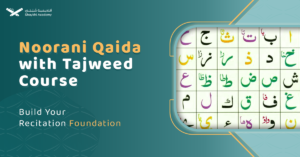
If certain sounds still feel unfamiliar, the Noorani Qaida, a beginner’s guide to Arabic letters and sounds, is the natural next step.

Learn to Pronounce the Quran Correctly with Shaykhi Academy
Getting one word right is a great start. Reciting the whole Quran correctly, though, takes a teacher who can listen to you, catch the small mistakes, and guide you letter by letter. That’s where Shaykhi Academy comes in.
Shaykhi Academy offers online Quran classes with Tajweed and Arabic for adults and children, taught in a systematic way by qualified tutors. Whether you’re still learning how to pronounce Quran or ready to perfect your recitation, there’s a course that fits your level:
- One-to-one live classes: Your teacher hears every sound you make and corrects it in real time, something no app or video can do.
- A step-by-step path: Start with the Noorani Qaida to master Arabic letters and sounds, then move on to the Tajweed course to recite with precision.
- Qualified, experienced tutors: Learn the Makharij and rules of Tajweed from teachers trained in Quranic recitation. [Add credentials, e.g., Ijazah or Al-Azhar graduates, if applicable.]
- Classes for the whole family: Programs for kids and adults, with [male and female teachers, if applicable].
- Flexible scheduling: Study from home, at times that suit your routine and time zone.
Whether your goal is to say “Al-Qur’ān” with confidence or to recite every surah beautifully, the right teacher makes all the difference.
Book your free trial class today and take your first step with confidence.
Explore Our Quran and Islamic Studies Courses:
- Quran Course for Adults
- Quran Memorization Course for Adults
- Ijazah Course
- Quran Recitation Course for Adults
- Islamic Studies Course
- Tafseer (Quran Interpretation) Course
- Quran Memorization Course for Ladies
- Quran Tajweed Course for Women
- Online Islamic Classes for Sisters by Female Tutors
- Online Tajweed Course
- Advanced Tajweed Course
Conclusion
Now you know how to pronounce Quran the way it’s meant to be heard: qur-‘ān, with a deep Qaf, a heavy Ra, a brief glottal stop, and a long, light “aa” before a clean “n.” In everyday English, “kuh-RAN” is common, but learning how to pronounce Quran in Arabic brings you much closer to the original.
When it comes to how to spell Quran, choose Quran for everyday writing and Qur’an for formal or academic work. Keep Koran for older titles and quotations.
Saying one word correctly is a meaningful first step. If you’re ready to recite the whole Quran with the same accuracy, a qualified teacher can guide you sound by sound.
Book your free trial class with Shaykhi Academy and start your Tajweed journey today.
FAQs
Is it pronounced “Koran” or “Quran”?
Koran and Quran are two spellings of the same word, and the correct pronunciation is the same for both: qur-‘ān. Saying it like “Koran,” with a light English “k” and no pause, is common in English, but it misses the deep Qaf and the glottal stop of the original Arabic.
How do you spell the Quran correctly?
The most widely accepted spelling is Quran, used by major style guides and most publications. Qur’an is a more precise form preferred in academic and religious writing. If you’re unsure how to spell the Quran, choose one of these two, use it consistently, and always capitalize it.
How do you spell Koran, and is it offensive?
Koran is spelled K-o-r-a-n. It’s an older English transliteration and isn’t considered a slur. However, it’s increasingly seen as outdated, and many Muslims prefer Quran because it better reflects the Arabic. Today, Koran mostly appears in older books, translations, and titles.
Why is the Q in Quran hard for English speakers?
English has no equivalent to the Arabic Qaf (ق). It’s produced at the very back of the tongue, near the uvula, deeper than an English “k.” Most English speakers substitute a “k,” which is why focused practice, ideally with a teacher, helps you master it.
Can I learn Quran pronunciation online?
Yes. Live one-to-one online classes let a qualified teacher hear your recitation and correct each sound in real time. At Shaykhi Academy, students start with the Noorani Qaida to master Arabic letters, then progress to Tajweed for accurate and beautiful Quran recitation.








One Response
Nice post. I learn something totally new and challenging on websites